NOAA has announced that Monarch Magnetics will produce HDGM and HDGM-RT going forward. Explore HDGM2027

IFR2

Time-varying correction for directional drilling.

IFR2 combines an IFR1 baseline with time-varying correction for external-field changes during magnetic surveys. Monarch provides SWC-CONUS and SWC-Alaska as regional temporal-correction products, with SWC-Global and local measurement options for other requirements.

Why IFR2

IFR1 establishes the local baseline. IFR2 accounts for how it changes with time.

An IFR1 solution provides the static/local magnetic-field baseline used for high-accuracy directional drilling. The external field changes with time as currents in the ionosphere and magnetosphere vary.

IFR2 combines that IFR1 baseline with a time-varying correction so magnetic surveys reflect conditions at the time of operation.

Monarch’s SWC products provide the temporal-correction layer. They can be combined with Monarch IFR1 or with a compatible IFR1 product already in the customer’s workflow.

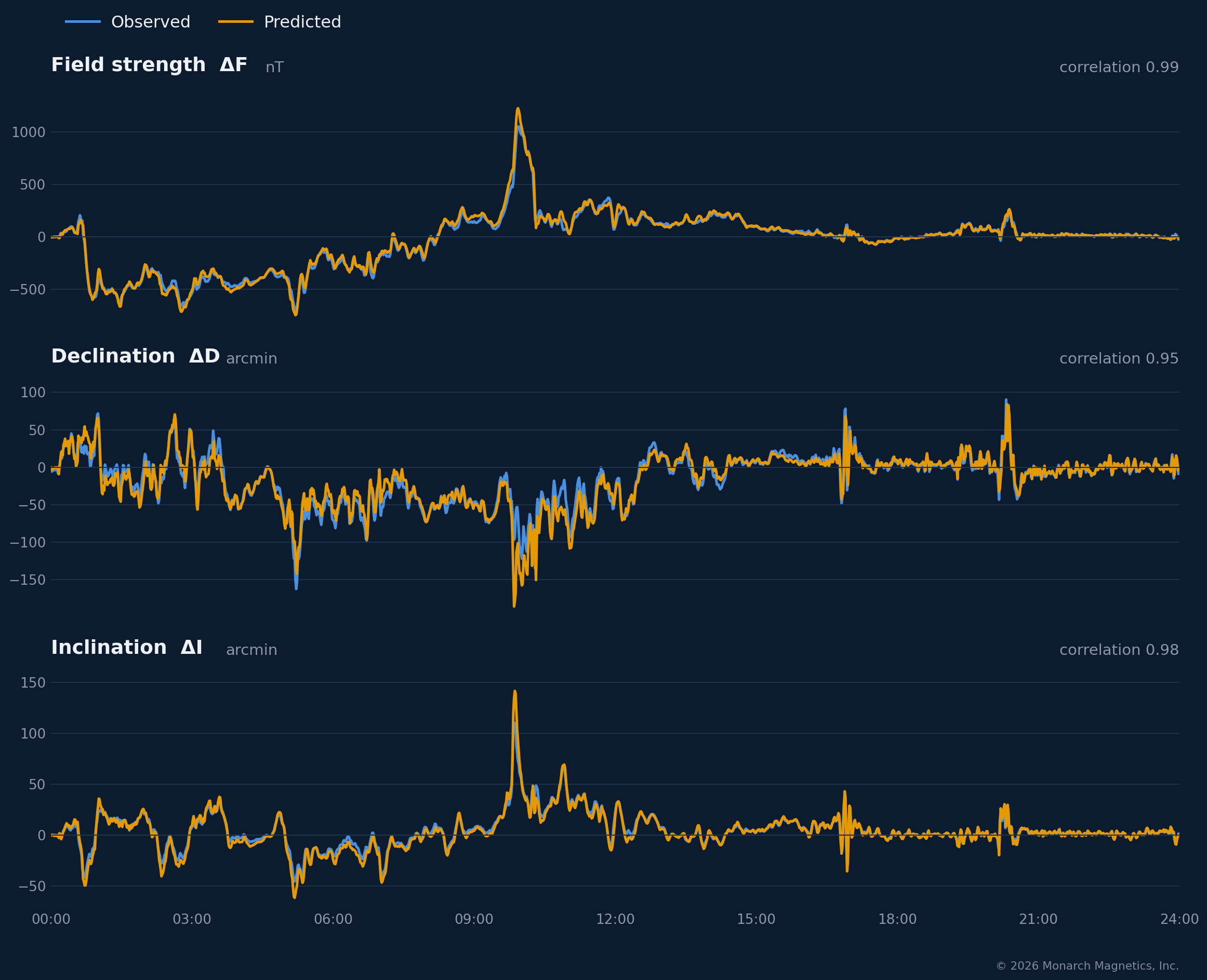
Observed and SWC-Alaska-predicted magnetic-field variations in field strength, declination, and inclination during a geomagnetic storm, showing close agreement through the day.
SWC-Alaska validation, 12 November 2025. Observed and predicted field-strength, declination, and inclination variations at an independent Alaska monitoring site. Observations: U.S. Geological Survey (USGS).

Regional correction

SWC-CONUS and SWC-Alaska provide the temporal layer for IFR2-equivalent regional solutions.

Space Weather Correction (SWC) uses magnetic observations and spatial modeling to estimate time-varying external-field changes away from observing sites. Combined with a compatible IFR1 baseline, SWC-CONUS or SWC-Alaska provides an IFR2-equivalent regional solution.

SWC-CONUS

Contiguous United States

SWC-CONUS uses U.S. geomagnetic-observatory data and spatial modeling to estimate external-field variations across the contiguous United States without requiring a local variometer at every drilling location.

With IFR1IFR2-equivalent solution
SWC-Alaska

Alaska

SWC-Alaska provides a separate regional correction for Alaska, where higher geomagnetic latitude can produce larger external-field variations and make time-varying correction especially important.

With IFR1IFR2-equivalent solution

SWC-Global

Global correction and HDGM-RT continuity.

SWC-Global provides worldwide time-varying magnetic-field correction using approaches suited to different geomagnetic regimes. When combined with IFR1, it provides a global temporal-correction option where regional or local correction is unavailable, although IFR1 + SWC-Global is not classified as IFR2 by ISCWSA. Separately, for legacy HDGM-RT users, HDGM2027 + SWC-Global carries forward HDGM-RT’s global time-varying external-field functionality.

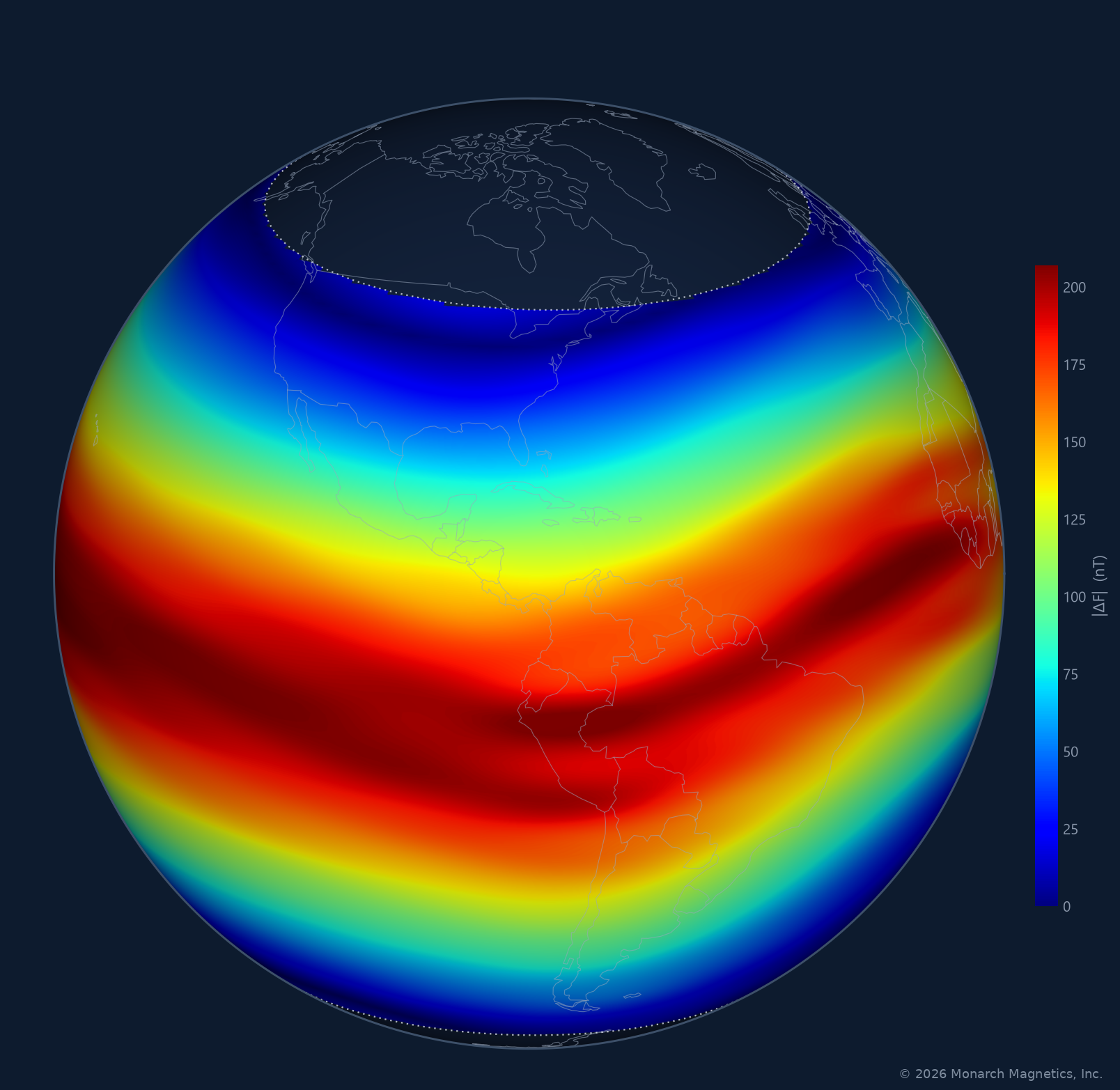
SWC-Global modeled field-strength disturbance over mid- and low latitudes during the 12 November 2025 geomagnetic storm.
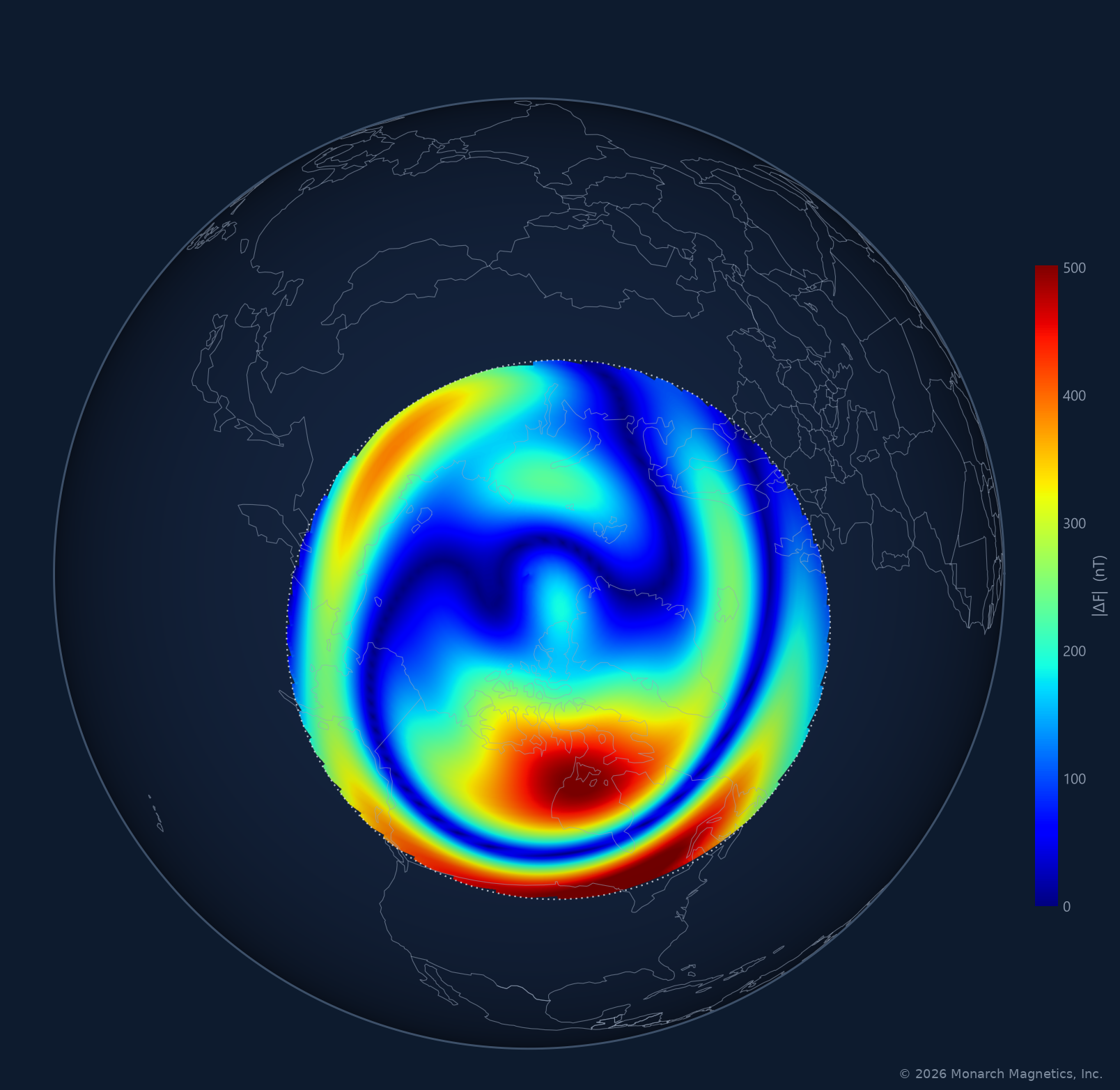
SWC-Global modeled field-strength disturbance over the northern polar region during the 12 November 2025 geomagnetic storm.

SWC-Global, 12 November 2025. Modeled field-strength disturbance at 08:30 UT, shown for mid- and low latitudes and the northern polar region. Input observations include U.S. Geological Survey (USGS) data and data from broader international geomagnetic providers.

Local correction

When additional local measurements are needed.

Where existing observatory coverage is insufficient, dedicated variometer measurements can provide the temporal-correction layer used with an IFR1 baseline. Depending on the requirement, this could include additional stations that extend regional, SWC-like modeling into new areas or a dedicated near-site deployment following the conventional IFR2 approach. These approaches can be considered where project requirements justify additional local measurements.

Validation & monitoring

Correction performance is tested against observations.

SWC products are evaluated against geomagnetic observations to quantify how well the correction reproduces time-varying magnetic-field changes. Monarch monitors SWC product performance in real time and sends alerts when performance is degraded by data gaps or other issues with the underlying observations.

The geomagnetic stack

IFR2 adds time-varying correction to the local magnetic-field baseline.

HDGM provides the global reference field. IFR1 adds local crustal refinement. IFR2 builds on the IFR1 baseline with the time-varying correction needed for conditions at the time of operation.

Time-varying correction

Need correction for a drilling location or operating area?

Contact Monarch with the location, operating period, existing IFR1 coverage, and correction requirements. We can determine whether SWC-CONUS, SWC-Alaska, SWC-Global, or a local correction approach is appropriate.

Monarch Magnetics Boulder, Colorado, USA